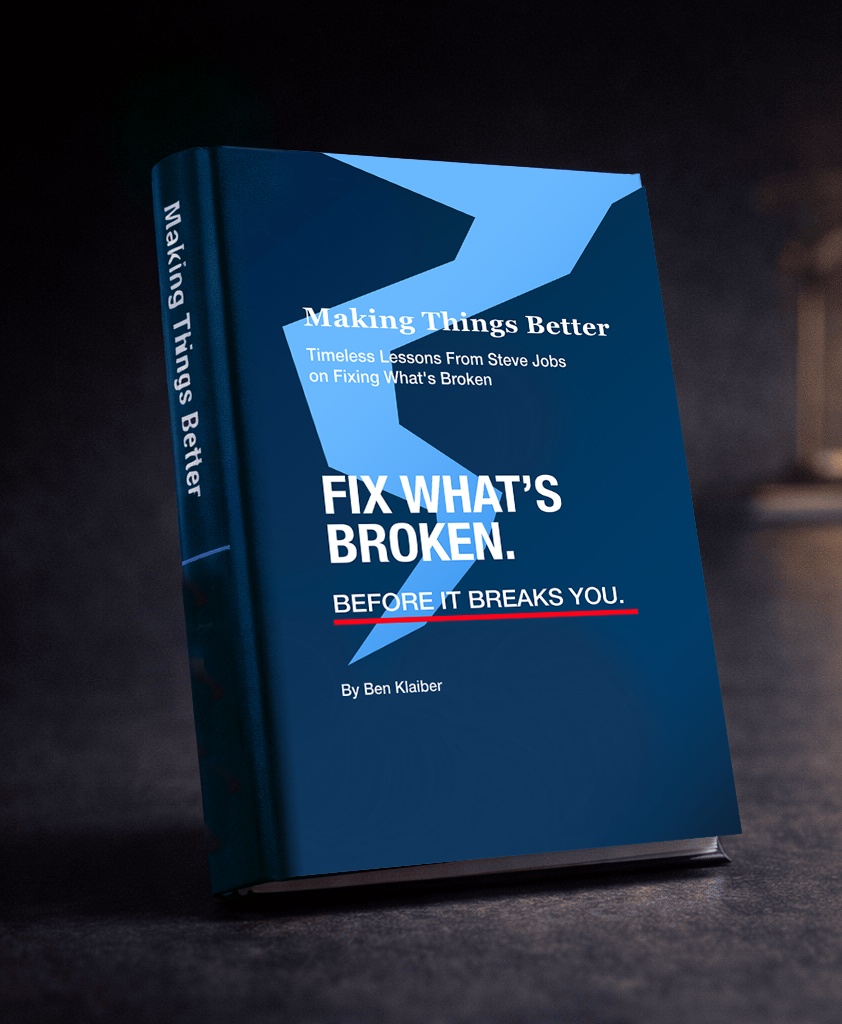
Timeless Lessons From Steve Jobs on Fixing What's Broken
by Ben Klaiber
FOR IMMEDIATE RELEASE
Media Contact: media@mmwbinc.com | 567-249-5075 | X: @bklaiber
Ohio - Jan. 2026 - Leaders do not run out of talent first. They run out of coherence. Tools stop agreeing, handoffs decay, incentives drift, and good people spend their days compensating for systems that no longer serve them.
In Making Things Better: Timeless Lessons From Steve Jobs on Fixing What's Broken, systems strategist and consultant Ben Klaiber distills the operational methods Jobs used to rescue Apple from near bankruptcy and rebuild it into the world's most valuable company. Not inspiration. Not mythology. Just repeatable patterns for spotting failure early, removing noise, and rebuilding clarity when the stakes are high.
"This is not a Steve Jobs biography and it is not hero worship. It is a field guide. Jobs did not win because of charisma or vision alone. He won because he was relentless about diagnosing what was actually broken - and courageous enough to fix it instead of cutting people to cover up dysfunction."
—Ben Klaiber
The book connects Jobs-era lessons to today's reality: software sprawl, cross-team drift, metrics that reward reporting over reality, and competitive environments where the right move is often to stand still and let the market move around you until conditions are favorable.
Availability: Ebook available now on Apple Books and Amazon Kindle. Print edition available by end of January 2026.
Apple Books: books.apple.com/us/book/making-things-better/id6756797507
Amazon Kindle: amazon.com/dp/B0G99H65V5
Review copies / interviews: Klaiber is available for interviews, podcasts, and talks on operational clarity, competitive positioning, and applying Jobs-style decision frameworks under pressure.
Click any quote to copy to clipboard
"Steve Jobs didn't predict the future. He identified the problems everyone else kept hitting and found systematic ways to avoid them. Not magic—metal detectors."
Chapter: Metal Detectors, Not Magic
"Vision implies unreplicable genius. Plans imply learnable methods. Vision can't be taught. Plans can be extracted, understood, and applied."
Chapter: Metal Detectors, Not Magic
"The arithmetic most companies get wrong: they measure activity instead of outcomes, process instead of progress, what's easy to track instead of what actually matters."
Chapter: Arithmetic
"'Impossible' often means 'expensive,' 'impractical,' or 'we've never tried.' Those are different problems requiring different solutions."
Chapter: The Glass Ceiling
"Breakthrough comes not from heroic individuals but from fixing the systems that produce results."
Chapter: Systems Over Heroes
"Apple's turnaround wasn't about innovation theater. It was about ruthlessly eliminating friction and building systems that worked with human behavior instead of against it."
Chapter: Introduction
Pre-written angles for journalists and podcast hosts
Copy-paste ready questions for journalists. Click to copy individual questions.
What inspired you to write a book challenging the Steve Jobs mythology?
You argue that "vision" is actually a myth that prevents replication. Can you explain that?
How is this book different from other business books about Apple or Steve Jobs?
What were the actual documented steps Jobs took to turn around Apple?
You write about "metal detectors, not magic." What does that mean?
How did Apple cut from 350 products to 10, and what can other companies learn from that?
What are the Five Surgical Questions, and how can leaders use them today?
Can you walk through a real example of a "hidden inefficiency" costing companies money?
How do these frameworks work in organizations that aren't Apple-sized?
You talk about "systems over heroes." What does that mean for modern leadership?
What's the difference between "whining" and "why-ning"?
How do you measure "dignity" in organizational systems?
Available in three lengths
Multiple length options - click to copy to clipboard
Ben Klaiber is Founder and Principal Workflow & Experience Architect at MMWB Inc., where he has spent twenty years helping organizations identify what's actually broken versus what people say is broken. Making Things Better is his first book.
Ben Klaiber is Founder and Principal Workflow & Experience Architect at MMWB Inc., where he has spent twenty years helping organizations identify what's actually broken versus what people say is broken. He's walked into startups burning cash on tools that don't talk to each other, mid-market firms drowning in their own data, and enterprise teams held hostage by systems built for reporting instead of reality. His consulting work spans Fortune 500 enterprises, mid-market firms, and venture-backed startups across industries including healthcare, logistics, financial services, and technology. Making Things Better distills two decades of field experience into frameworks any leader can apply. He lives in Ohio.
Ben Klaiber is Founder and Principal Workflow & Experience Architect at MMWB Inc., where he has spent twenty years helping organizations identify what's actually broken versus what people say is broken.
He's walked into startups burning cash on tools that don't talk to each other, mid-market firms drowning in their own data, and enterprise teams held hostage by systems built for reporting instead of reality. His consulting work spans Fortune 500 enterprises, mid-market firms, and venture-backed startups across industries including healthcare, logistics, financial services, and technology.
Unlike consultants who arrive with prefabricated frameworks, Klaiber's method involves systematic diagnosis: tracing information flows, identifying friction points, and measuring the real cost of broken workflows—not in vague productivity loss, but in actual wasted employee hours, missed revenue, and organizational drag.
Making Things Better distills two decades of field experience into practical frameworks leaders can apply immediately. The book emerged from a simple observation: companies kept hitting the same problems, and the solutions already existed in documented form—they just weren't framed as systems anyone could replicate.
Klaiber holds degrees in both technical systems and human behavior, a combination that informs his approach to organizational design. He lives in Ohio with his family.
Speaking Topics: Organizational systems, workflow optimization, documented vs. mythological leadership, strategic subtraction, hidden inefficiencies
Review copies available in Kindle, Apple Books, and Print (February 2026)
To request a review copy, please email Media@mmwbinc.com with: