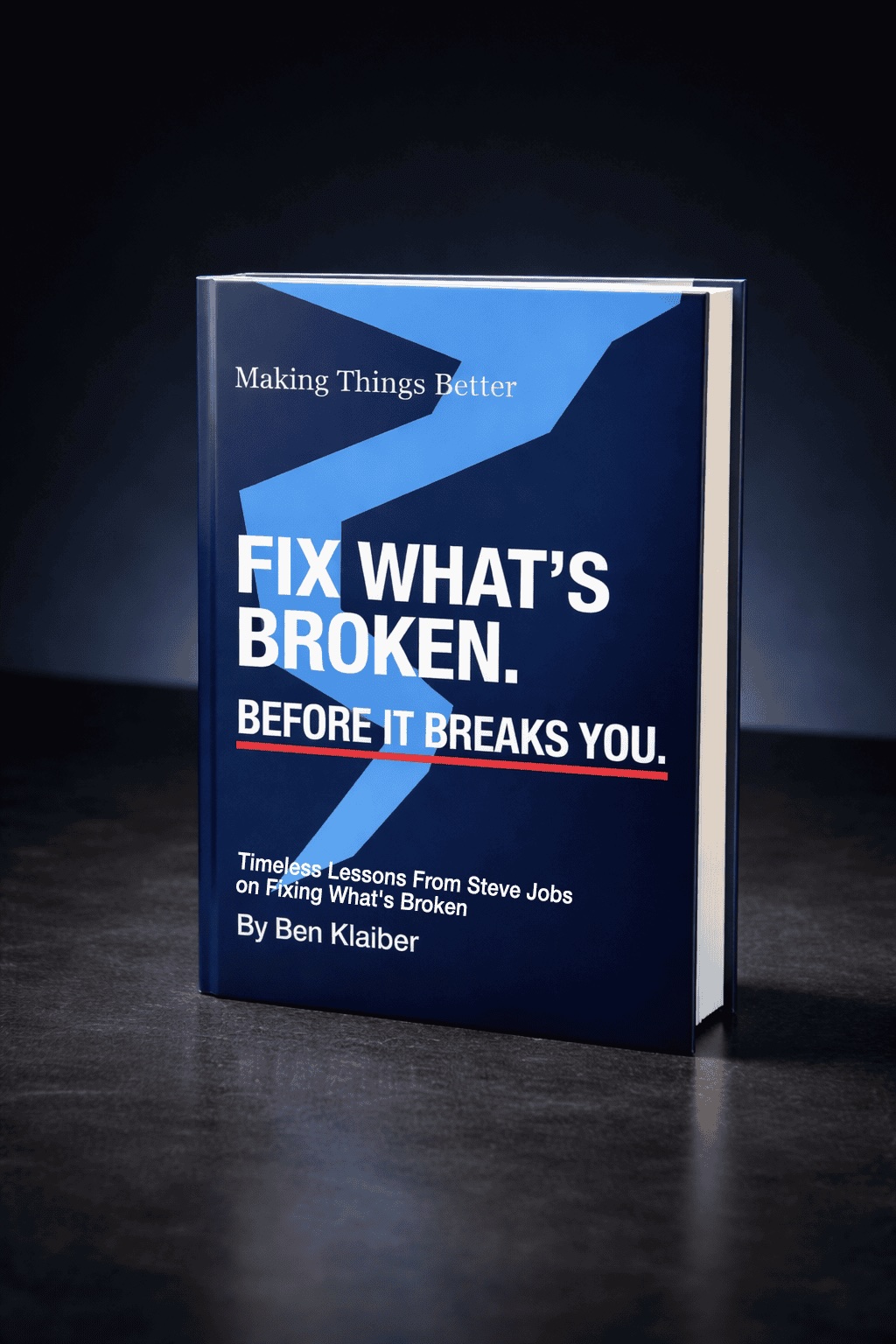
Making Things Better
Timeless Lessons From Steve Jobs on Fixing What's Broken
A field guide to diagnosing failure, eliminating noise, and restoring coherence at scale - using the repeatable methods Steve Jobs used to rescue Apple.
Join readers fixing what's broken
This isn't another Steve Jobs biography. It's a diagnostic toolkit for leaders facing broken systems, organizational dysfunction, and the comfortable lies that keep both in place.
Diagnostic tools you can use Monday morning
Every lesson backed by verifiable facts
Refined through twenty years of consulting work across industries
Frameworks work whether you're running Fortune 500 divisions or five-person startups
"Breakthrough doesn't come from heroic individuals. It comes from fixing the systems that produce results.
Organizations today lose enormous amounts of time and money not to effort or talent gaps—but to information breakdowns: tools that don't talk to each other, workflows that fight human behavior, and systems optimized for reporting instead of reality.
Making Things Better argues that these failures are not inevitable. They are diagnosable, fixable, and often hiding in plain sight. The book provides a practical lens for leaders navigating AI adoption, software sprawl, and operational complexity without sacrificing people or performance.
"This is not about heroic individuals. Breakthrough comes from fixing the systems that produce results."
—From the Introduction
At a time when organizations face pressure to do more with less, this book offers a different approach: diagnose what's broken, eliminate friction systematically, and build environments where talented people can actually do their best work.
"Steve Jobs didn't predict the future. He identified the problems everyone else kept hitting and found systematic ways to avoid them. Not magic—metal detectors."
Chapter: Metal Detectors, Not Magic
"Bozos are just a fact of life in business. If you want to be successful, the faster you can identify them, and the more nimble you become in neutralizing their influence, the better off you and your business will be."
Chapter: Bozos Aren't Brilliant
"Vision implies unreplicable genius. Plans imply learnable methods. Vision can't be taught. Plans can be extracted, understood, and applied."
Chapter: Metal Detectors, Not Magic
"The arithmetic most companies get wrong: they measure activity instead of outcomes, process instead of progress, what's easy to track instead of what actually matters."
Chapter: Arithmetic
"'Impossible' often means 'expensive,' 'impractical,' or 'we've never tried.' Those are different problems requiring different solutions."
Chapter: The Glass Ceiling
"Whining asks: 'Why did this happen to us?' Why-ning asks: 'Why did this happen, and how do we prevent it?'"
Chapter: Whining vs. Why-ning
Learnable patterns you can apply to any organization, regardless of scale or industry
Diagnostic framework for identifying root breaks
Metrics that actually matter versus vanity KPIs
Systematic vigilance over visionary thinking
Identifying and neutralizing toxic patterns
How Apple's product line reduction from 350 to 10 created competitive advantage
How to tell your story before critics define it for you
In September 1995, while Apple was floundering, Steve Jobs told Fortune magazine: "You know, I've got a plan that could rescue Apple. I can't say any more than that it's the perfect product and the perfect strategy for Apple. But nobody there will listen to me."
Notice what he did not say.
He did not say "I have a vision."
He did not say "I see the future."
He said "I have a plan."
A plan is not magic. It is logic, sequence, and trade-off. It is knowing where the landmines are and how to avoid them.
Yet many still insist Steve's success was supernatural. Some kind of fluke of genius, impossible to replicate. This belief does more than mislead. It disempowers.
It turns leaders into spectators, waiting for a messiah instead of sharpening their own tools.
The truth is simpler and far more useful: Steve did not predict the future. He designed it. And he left a trail of evidence so clear, it's like he handed us the map.
Anyone responsible for improving how work gets done
Chapter 7: The Glass Ceiling
Chapter 12: Whining vs. Why-ning
Chapter 5: Metal Detectors
Chapter 14: Arithmetic
Chapter 9: The Copy-Paste Tax
This entire book is for you
Publisher
Framewise Press
Release Date
December 2025
ISBN (eBook)
978-1-7363032-2-7
Experience
20 years consulting
Steve Jobs didn't predict the future. He identified the problems everyone else kept hitting and found systematic ways to avoid them.
When Jobs returned to Apple in 1997, he inherited 350 products. Most were confusing, mediocre, or both. Instead of trying to make each one slightly better, he did something more surgical: he cut the product line to ten items organized in a simple grid...
Download Full Sample ChapterSystematic problem identification
Root cause diagnosis framework
Measuring what actually matters
When less is exponentially more
From complaint to correction
Identifying and neutralizing dysfunction
Pattern recognition in problem solving
Core elements of system repair
Understanding true value creation
Managing transition periods
Executing organizational recovery
Building lasting trust
Recovery from critical failure
Action over analysis
Pattern recognition across problems
Removing barriers to execution
Sustaining team motivation
Taking action on your insights
"Confrontational"
This book challenges every comfortable assumption about how organizations work.
"Essential"
Finally, a book that addresses what's actually broken in modern organizations.
"Actionable"
Not theory — these are frameworks you can use on Monday morning.
Ben Klaiber is Founder and Principal Workflow & Experience Architect at MMWB Inc., where he has spent twenty years helping organizations identify what's actually broken versus what people say is broken.
He's walked into startups burning cash on tools that don't talk to each other, mid-market firms drowning in their own data, and enterprises where everyone knew the dashboard was lying but nobody knew how to fix it.
20+ years
Consulting across Fortune 500 divisions and five-person startups
Founder, MMWB Inc.
Principal Workflow & Experience Architect
Author
Making Things Better: Timeless Lessons From Steve Jobs
Stop accepting broken workflows as inevitable. Start fixing what's draining your organization.
471 pages • $12.99 (Apple Books) • $19.99 (Print)
© 2025 Ben Klaiber. All rights reserved. Published by Framewise Press.
Fix What's Broken. Before It Breaks You.
471 pages of actionable frameworks