Most software is built around platform logic, not people logic. We fix that — either by working with the teams building it before it ships, or by making it actually work for the people already stuck with it. The concepts here show how we think. The work shows what we do with it.
Cognitive overload, context switching, notification fatigue — these show up in workplace productivity surveys every year. The data is consistent. The frustration is widespread. And yet the software ships the same way it always did. We built these concepts because they're what we want to be using daily — on the platforms millions of people already rely on. If you work at one of those platforms, we'd genuinely love to talk.
Reaction Intelligence · Signal-Driven Recommendations · Love / Like / Never
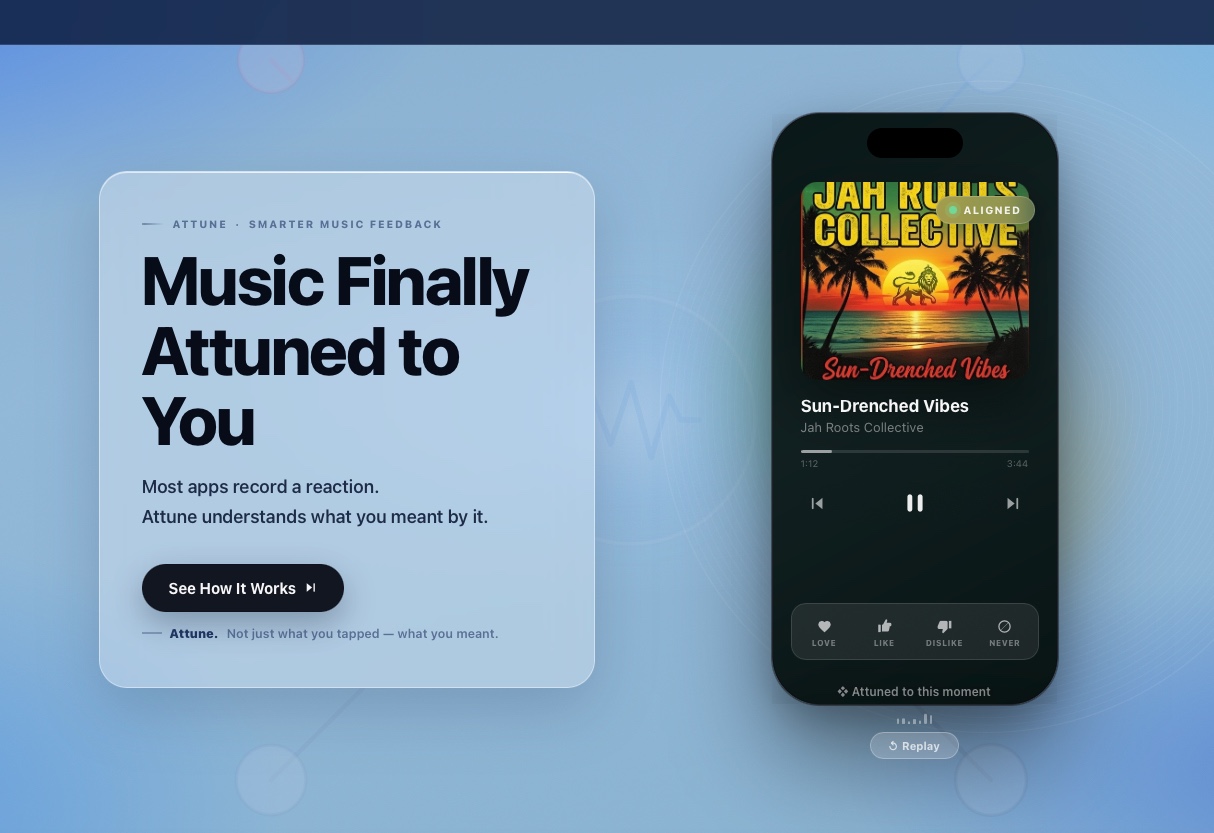
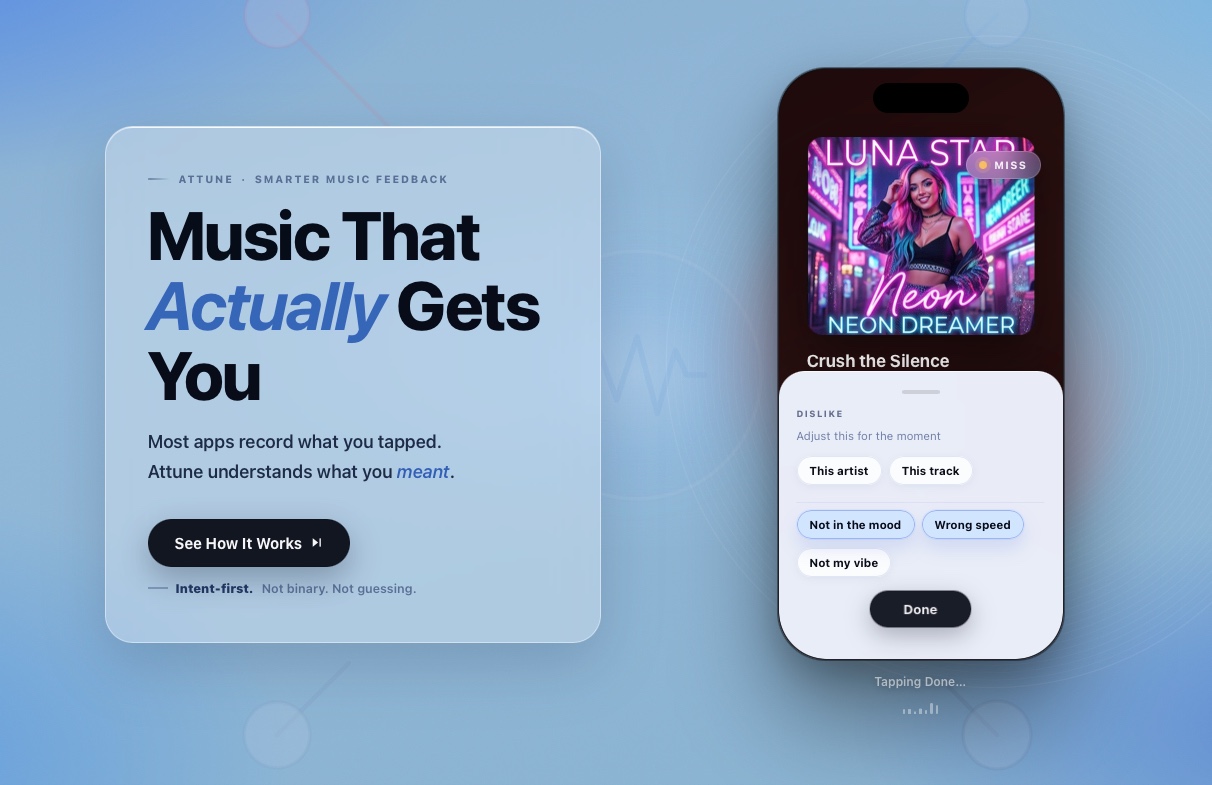
Sophisticated algorithms. Billions of data points. And yet every major platform shares the same fundamental blind spot: they can't tell the difference between what you mean and what you tapped. A like in the background while you're cooking isn't the same as a like you stopped to search for. A skip at the end of a song isn't the same as a skip at the start. The input looks identical. The intent couldn't be more different.
Binary feedback trains a fundamentally imprecise model. Attune separates reactions into three distinct signals — Love, Like, and Never — each with layered intent, so the algorithm finally learns what listeners actually mean, not just what they tapped.
Relationship Logic · Time-Aware Tiers · Contact-First Design
Apple built a volume knob. What you actually needed was a schedule. Focus modes are configured the way a developer thinks about device states — not the way a person thinks about their life. There's no Morning. No Evening. No theory of who matters when. Your relationships are invisible to the system, and your day has no shape it can recognize.
Conduct is built on the premise that a person's day has a shape, their relationships have a structure, and any system worthy of managing their attention must understand both. Build-a-Day maps your actual schedule. Tiered contact logic sets access by relationship — one decision per person, pushed to every app at once.
Pivot Filtering · Held for Safety · Smart Bulk Actions
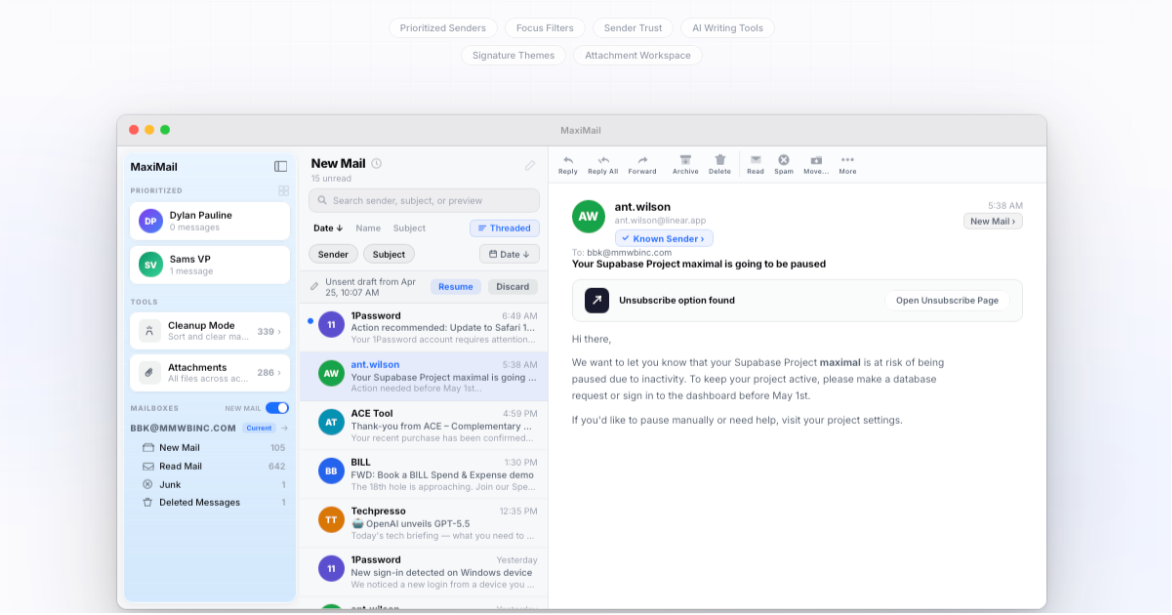
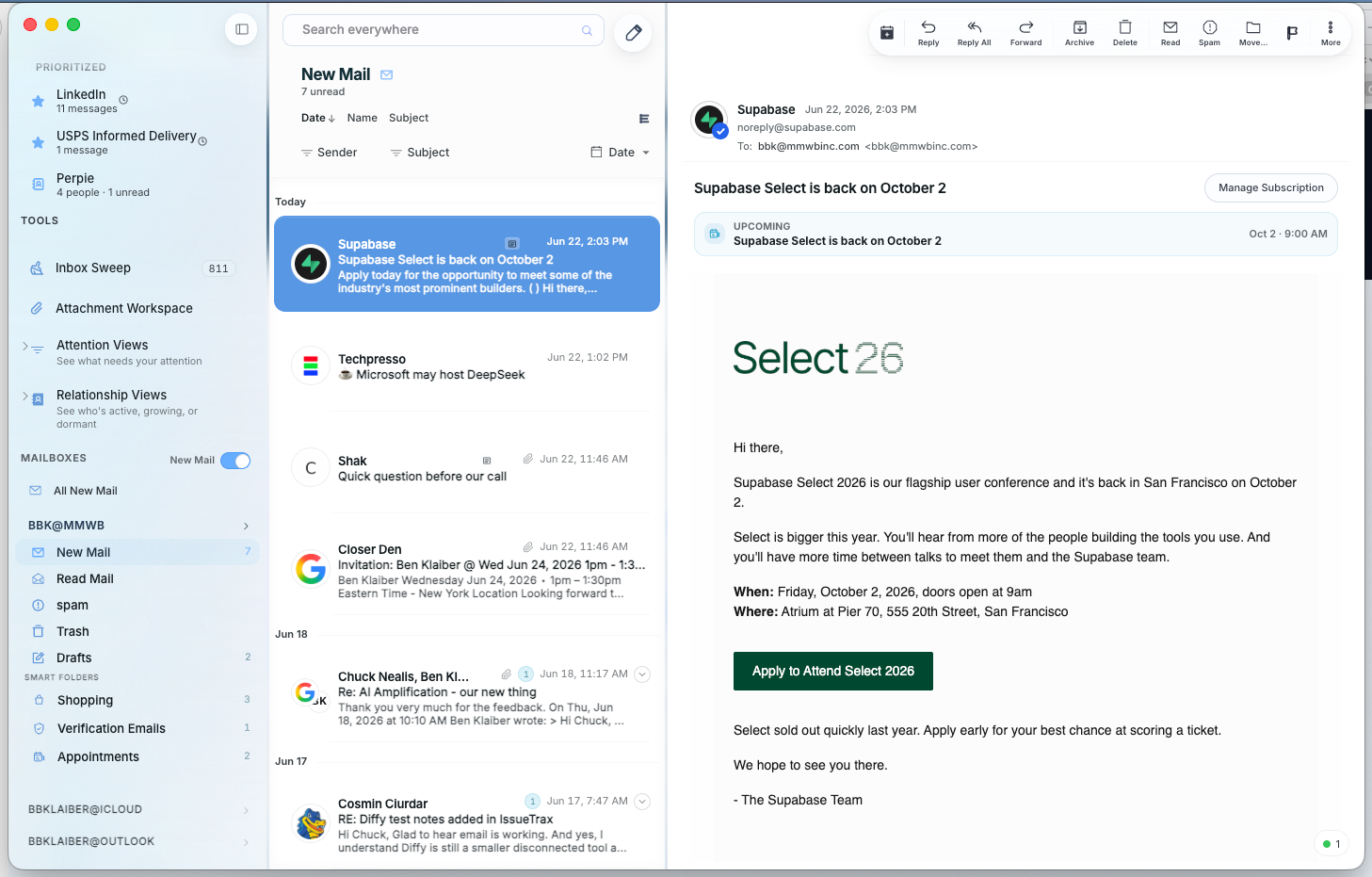
Modern email clients optimize for platform risk and global policy — not for you. The result is an inbox you can't fully trust: real messages buried in junk, corrections that don't stick, important senders treated like noise, and suspicious mail silently hidden instead of explained. The controls that would fix it are buried three menus deep, if they exist at all.
Inference outranks intent. Relationships are invisible to the routing logic. And risk gets buried instead of surfaced. MMWBMail flips the hierarchy: your intent dominates, your relationships matter, and important messages stop disappearing — across 14 features built around one rule: user intent first, always.
8 themes · 25 features · Precision messaging
Microsoft Teams is already the tool your organization trusts for premier business communication. But it ships with gaps that compound quietly — a misspelled product name in a client channel, an unanswered message that slips through, three teammates responding to the same support request with three different answers. None of it is dramatic. All of it has a cost.
The tool that carries your most consequential conversations was never designed for precision. TrueTeams proposes 25 features across 9 themes to close the gap — brand integrity, follow-through, focus, clarity, and accountability — without a single new install.
Context Anchoring · Device Hierarchy · Per-App Budgets
You dismiss a notification on your laptop. It reappears on your phone. You dismiss it again. Your watch taps your wrist. You've now given three seconds of attention to the same piece of information and still haven't actually dealt with it. Meanwhile, the thing you were doing has cooled. You've been interrupted by a system with no memory of what it already told you.
Modern notification systems forget what you just handled, ignore your other devices, and force all-or-nothing overload. This concept restores memory, hierarchy, and sane limits.
Persistent Reference · Less Switching · Better Flow
You have a document open and a reference you keep needing to check. You switch to it, read something, switch back — and you've lost your place. You switch again to reread it. By the time you're back in the document, the thought you were mid-way through is gone. You spent forty-five seconds not working. And you'll do it eleven more times today.
Important reference windows vanish behind the task at hand. One simple keep-on-top control preserves context, cuts hunting, and protects momentum.
Most software is built from the technology inward. We start from the person — and work outward until the experience is the kind users can't imagine going back from.
Start from the human. Every brief starts with behavior, not requirements. We ask what the user actually experiences before we ask what the product should do.
Work outward. Logic first, interface second, technology last. It keeps the experience coherent under pressure.
Ship something leagues ahead. We don't optimize existing patterns. We find the version users didn't know was possible — then make it inevitable.
Modern software is full of expertise and short on empathy. Features get shipped to hit KPIs, not to honour how people actually work. We believe software should be a tool — not a trap.
Every concept we build starts from one question: what is the user actually trying to do, and what's getting in their way?
What you explicitly do matters more than what an algorithm guesses you want.
If a common action takes multiple screens and a detour into settings, it's broken by design.
Who you reply to, how often, how recently — this should shape how software treats their messages.
When software makes a decision about your data, it should show its work — not bury it in a help article.
The best features make users ask: 'why didn't this exist before?' That's the standard we build to.
Whether you need a concept explored, a workflow untangled, or software your team has outgrown, we help expose the stronger version hiding inside it.
Redesigned checkout flows and decision points that surface intent at the right moment — removing the friction that kills deals before they close.
Systems that surface patterns from your existing data — no new stack required. The signal was always there. We build the interface that makes it visible.
Concepts built to collapse the steps between intent and outcome — restoring hours, reducing overhead, and keeping teams moving without the drag.