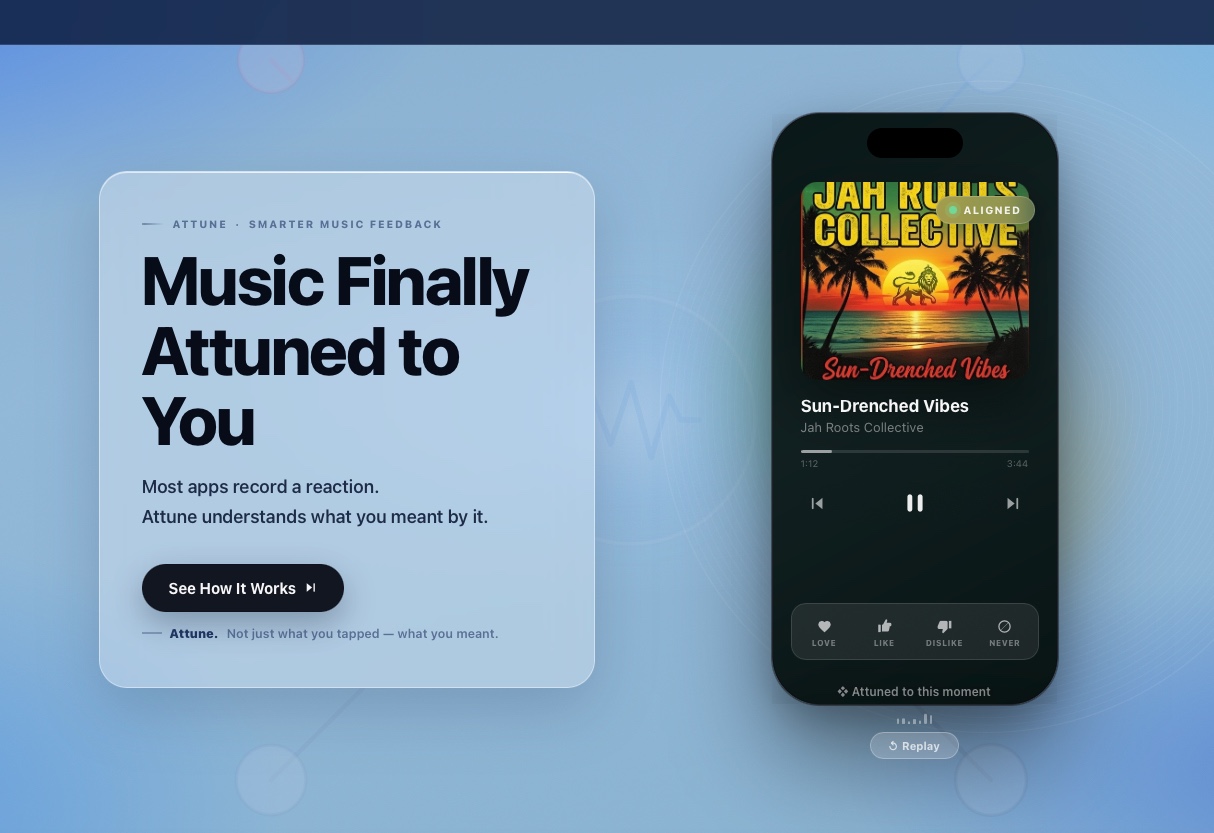
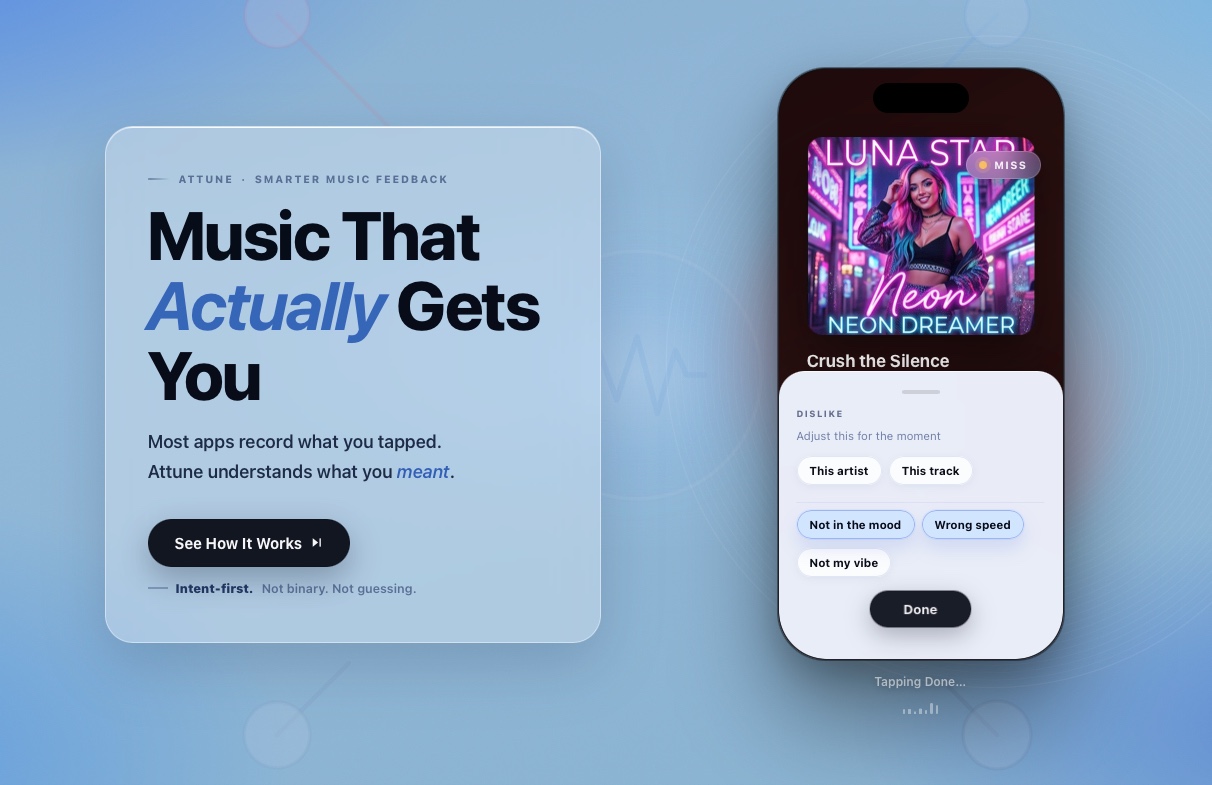
Attune. Music that gets the Vibe.

Try this nextYour reactions become the algorithm.
A like in the background while you're cooking isn't the same as a like you stopped to search for.
Open concept →Most software is built around platform logic, not people logic. The Workshop is where we show our thinking. Every concept here fixes something that should never have been broken in the first place.
We start from the person — and work outward until the experience is the kind users cannot imagine going back from.
Cognitive overload, context switching, notification fatigue — the frustration is widespread. These concepts are what we want to be using daily, on the platforms millions already rely on.

Try this nextYour reactions become the algorithm.
A like in the background while you're cooking isn't the same as a like you stopped to search for.
Open concept →Right person.
Right time.
Your relationships are invisible to the system, and your day has no shape it can recognize.
Open concept →Keep context where you need it.
The things that matter should stay present without taking over your whole screen.
Open concept →Knowledge in the flow of work.
The tool that carries your consequential conversations should have clarity, accountability, and memory.
Open concept →Fewer.
Smarter.
Timely.
Modern notification systems forget what you just handled and force all-or-nothing overload.
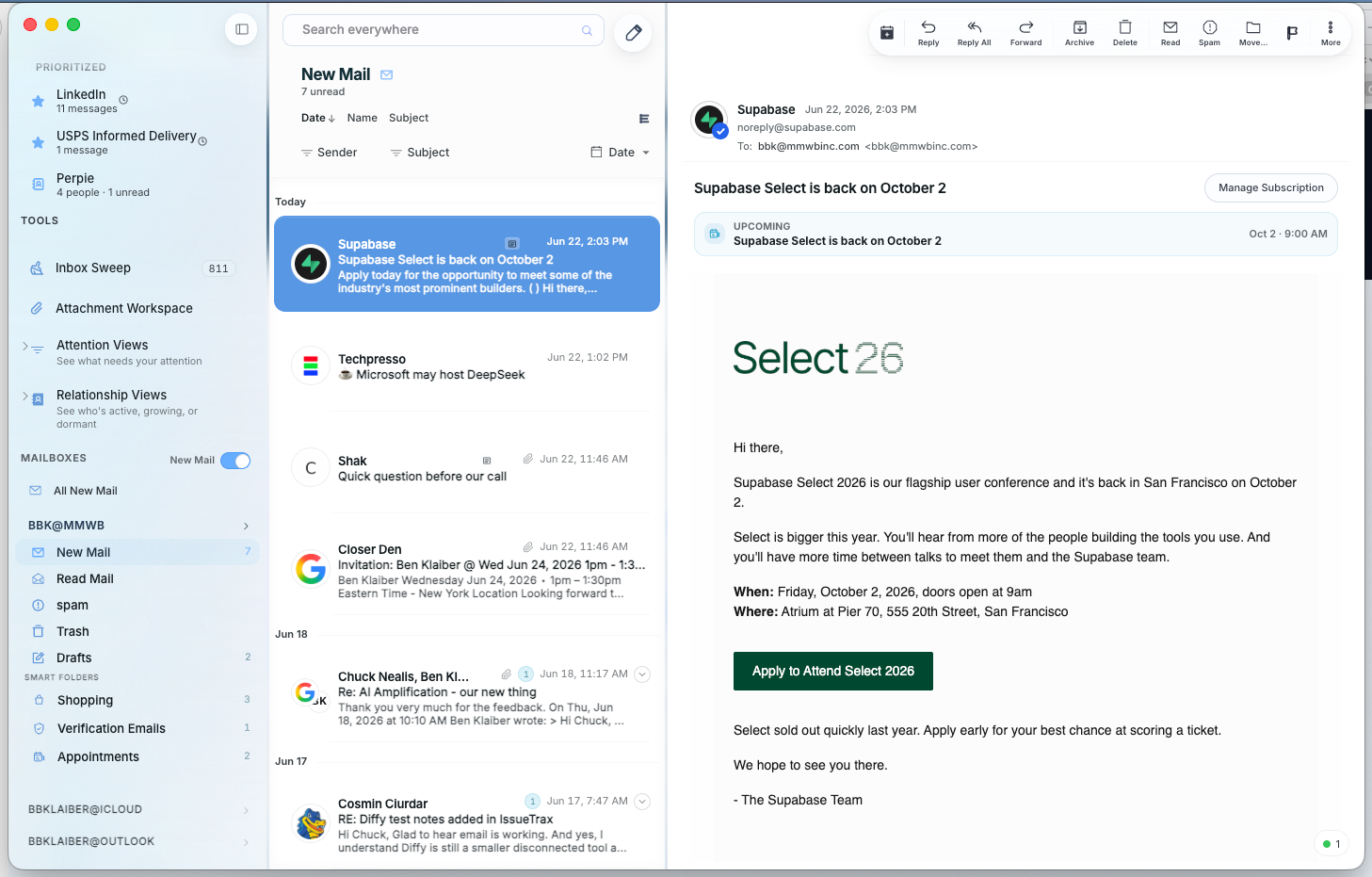
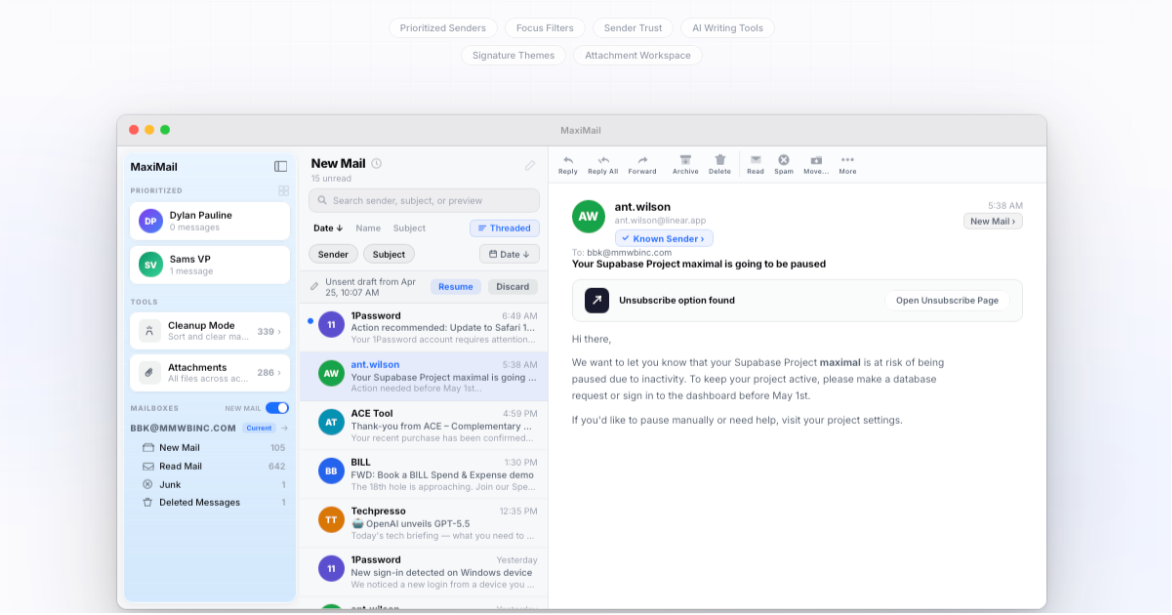
Open concept →Maximum clarity, less inbox drag, better control — built around the real moves people make every day.
Clarity in every pane.
Explore MaxiMail →
Every Workshop concept begins by watching where existing software breaks the natural flow of work, attention, or decision-making. Then we reduce the problem to its underlying behavior and build outward from there.
Start with real behavior, not what the software assumes people are doing.

Strip away the interface conventions. Find the actual decision, interruption, handoff, or behavior underneath.
Turn the reframed problem into something concrete enough to test, refine, and eventually ship.

You do not need to know whether the problem is workflow, interface, product logic, data, or the handoffs between them. Most of the time, the first useful signal is simply that something feels harder than it should.
Your team has already built workarounds around the system — extra clicks, duplicate entry, side spreadsheets, manual checks, or messages outside the tool. Nothing is technically broken. Too much effort is required to make it work.
Features accumulated. Customer behavior changed. What once felt simple now requires explanation, training, memory, or increasingly elaborate navigation.
There is a real problem and a real opportunity, but jumping directly into requirements would freeze too many assumptions before the underlying experience is understood.
You may not yet know whether the issue lives in the workflow, interface, product logic, data, or the seams between them. That uncertainty is often exactly where the useful work begins.
We do not begin by assuming you need a replacement.
We look at how the software actually behaves in the hands of your team and customers: where people hesitate, repeat work, leave the system, compensate for missing logic, lose context, or work around decisions the product made for them.
Then we redesign the weak points while respecting what already works.
Sometimes the highest-return software project is the one that keeps the software you already bought.
Talk to us about what you have →For new products, internal tools, and major new capabilities, we work upstream.
Before the roadmap locks the answer in place, we help define the actual user behavior, decision structure, workflow, edge cases, and experience the software needs to support.
Then architecture and interface can serve the experience instead of dictating it.
The earlier the assumptions get challenged, the less expensive they are to change.
Talk to us about what you’re building →Different starting points. Same principle: technology should conform to the work and the person, not force the work and the person to conform to it.
The Workshop is how we show our thinking. The engagement is how we put it to work.
Most software improvement starts with a feature list or a replacement search. We start by asking a different question:
What is the current system preventing people from doing naturally?The answer is often not “buy something new.” It may be a broken handoff, buried capability, bad default, missing piece of context, redundant decision, or an interface that no longer reflects how the work actually happens.
Checkout
Lead handling
Conversion decisions
Customer follow-up
Sales handoffs
Existing data
Institutional knowledge
Relationship context
Decision history
Approvals
Repeated entry
Context switching
Search
Manual coordination
The software should guide good behavior naturally instead of depending on training, memory, and workaround discipline.
We find the highest-return improvement in the system you actually have, with the people who actually use it.
We meet you with the right energy: clear thinking, strong systems, and a human point of view.
Get in touch ↗
Attune / intent first
MaxiMail / shipping